
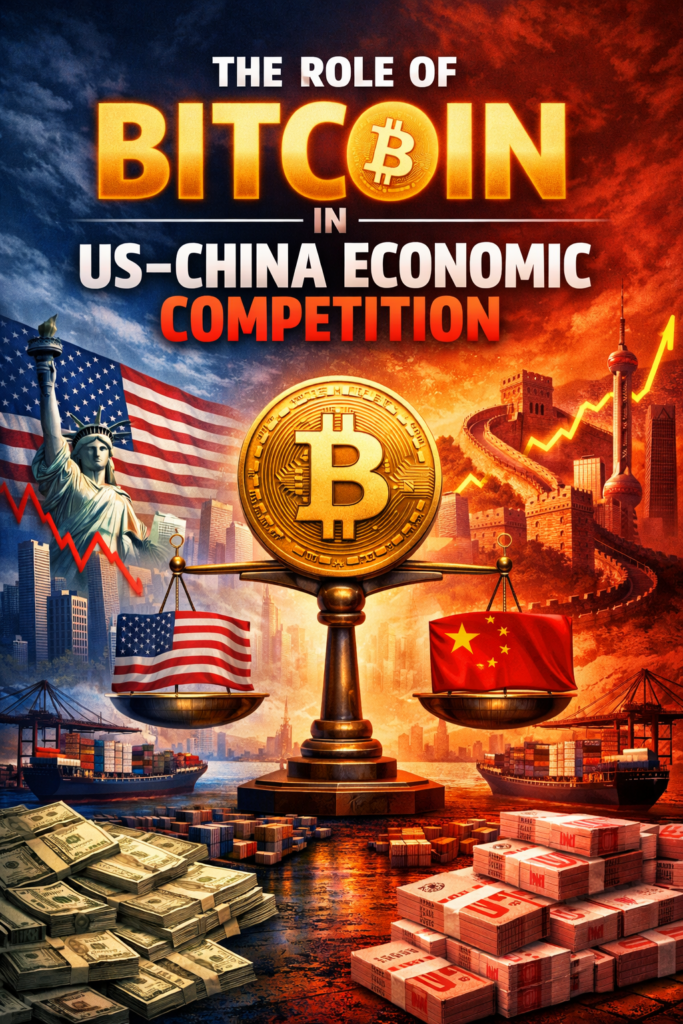
Content Outline
- Introduction
- Overview of the US–China Trade Relationship
- The Role of Currency in Global Trade
- Bitcoin as a Neutral Financial Asset
- China’s Stance on Bitcoin
- The United States’ Approach to Bitcoin
- Bitcoin’s Influence on US–China Trade Dynamics
- Opportunities and Risks
- Future Outlook
- Conclusion
- FAQs
Global trade is no longer just about goods, tariffs, and supply chains. It is increasingly about control over money itself. As tensions grow between the United States and China, a parallel shift is happening. Decentralized finance is rising, and Bitcoin is at the center of it.
You are witnessing a moment where financial power is being redefined.
Bitcoin, created in 2009, is a decentralized digital currency that operates without a central authority. It runs on a blockchain, allowing peer-to-peer transactions that are transparent, secure, and resistant to censorship. Unlike traditional currencies, it has a fixed supply of 21 million coins, which makes it inherently scarce.
At first, Bitcoin seemed disconnected from geopolitics. But that is no longer the case.
Today, digital currencies are becoming intertwined with global trade dynamics. As countries compete for economic dominance, control over financial systems has become a strategic priority. This is where Bitcoin enters the conversation.
Thesis: Bitcoin is emerging as a neutral financial asset that intersects with the US–China trade relationship, influencing currency competition, trade settlements, and the broader balance of economic power.
2. Overview of the US–China Trade Relationship
To understand Bitcoin’s role, you need to look at the foundation of global trade today.
Trade between the United States and China expanded rapidly after China joined the World Trade Organization in 2001. By 2022, bilateral trade exceeded $690 billion, making it one of the largest trade relationships in the world.
However, this growth came with friction.
The United States has long raised concerns about trade imbalances, intellectual property rights, and market access. These tensions escalated into the US–China trade war between 2018 and 2020, where both countries imposed tariffs on hundreds of billions of dollars’ worth of goods.
Even today, the relationship remains complex.
You are looking at a system where competition and cooperation coexist. The US relies on China for manufacturing, while China depends on access to US markets and financial systems. At the same time, both nations are competing in critical sectors like semiconductors, artificial intelligence, and financial technology.
At the heart of this rivalry is currency dominance.
The US dollar accounts for roughly 58% of global foreign exchange reserves and is used in about 80–90% of international trade transactions. This dominance gives the United States enormous influence over global finance.
China, on the other hand, is actively working to increase the global use of the yuan. While the yuan’s share of global reserves is still under 3%, its role is growing through trade agreements and financial partnerships.
This is where the story starts to shift. Because neither system is perfect.
3. The Role of Currency in Global Trade
If you want to understand global trade, you need to understand money.
The US dollar dominates because it is trusted, liquid, and backed by strong institutions. It is deeply embedded in global systems like SWIFT, which facilitates international payments. This infrastructure allows the US to enforce sanctions and influence global financial flows.
But this dominance comes with consequences.
Countries that rely on the dollar are exposed to US monetary policy and geopolitical decisions. This has led many nations, including China, to seek alternatives.
China’s push for yuan internationalization is part of a long-term strategy. Initiatives like the Belt and Road program and bilateral trade agreements aim to increase yuan usage. More recently, China introduced the digital yuan, a central bank digital currency designed to modernize payments and expand global reach.
Still, traditional fiat systems have clear limitations.
Cross-border transactions are often slow and expensive, involving multiple intermediaries. Settlement can take days. Fees can be significant. And access is not universal.
This is where Bitcoin changes the equation.
Bitcoin operates outside traditional systems. It allows direct transactions without intermediaries. It is global by design. And it does not depend on trust in any single government.
You can already see why this matters in a world shaped by economic rivalry.
4. Bitcoin as a Neutral Financial Asset
Bitcoin’s real power lies in its neutrality.
It is not controlled by any country, central bank, or corporation. Its rules are enforced by a decentralized network of participants. This makes it fundamentally different from both the dollar and the yuan.
When you use Bitcoin, you are not relying on a government or financial institution. You are interacting with a protocol.
This creates several advantages.
First, Bitcoin is borderless. You can send value anywhere in the world in minutes, regardless of political boundaries. Second, it is censorship-resistant. Transactions cannot easily be blocked or reversed. Third, it is transparent. Every transaction is recorded on a public ledger.
Compare this to traditional finance.
In the existing system, cross-border payments often involve banks, clearinghouses, and regulatory approvals. Each step adds time, cost, and complexity. In contrast, Bitcoin simplifies the process.
This is why Bitcoin becomes particularly attractive during geopolitical uncertainty.
When trust in centralized systems weakens, you look for alternatives. Bitcoin offers a system that is predictable, scarce, and independent.
For global trade participants, this neutrality is not just a feature. It is a strategic advantage.
5. China’s Stance on Bitcoin
China’s approach to Bitcoin has been decisive and, at times, aggressive.
At one point, China accounted for over 65% of global Bitcoin mining. But in 2021, the government launched a sweeping crackdown on cryptocurrency mining and trading. Exchanges were shut down, and financial institutions were prohibited from facilitating crypto transactions.
The impact was immediate. Bitcoin’s hash rate dropped sharply before recovering as mining operations relocated to countries like the United States and Kazakhstan.
Why did China take such a strong stance?
The answer lies in control.
Bitcoin challenges China’s ability to regulate capital flows. It enables individuals to move money خارج traditional systems, which conflicts with the country’s strict capital controls. It also introduces financial risks that are difficult to monitor.
At the same time, China has been investing heavily in its own alternative: the digital yuan.
The digital yuan is designed to enhance state control while improving efficiency. It allows the government to track transactions, enforce policies, and potentially expand its influence in global trade.
From a strategic perspective, restricting Bitcoin while promoting a state-controlled digital currency makes sense.
It allows China to maintain control while still participating in the digital transformation of finance.
6. The United States’ Approach to Bitcoin
The United States has taken a different path.
Rather than banning Bitcoin, it has allowed innovation to develop within a regulatory framework. While policies are still evolving, the US has positioned itself as a hub for crypto development.
Institutional adoption is one of the most significant developments.
You are seeing major corporations, hedge funds, and asset managers entering the space. Bitcoin ETFs have opened the market to a broader range of investors. Public companies have added Bitcoin to their balance sheets.
This level of adoption brings credibility.
It also reflects a broader narrative. Many investors view Bitcoin as a hedge against inflation and monetary expansion. With global debt levels rising and central banks increasing money supply, Bitcoin’s fixed supply becomes more attractive.
From a strategic standpoint, the US benefits from embracing crypto innovation.
It attracts talent, capital, and technological leadership. It also allows the US to shape the regulatory environment and influence the future of digital finance.
This openness creates a contrast with China’s restrictive approach.
7. Bitcoin’s Influence on US–China Trade Dynamics
Now you can start to see how Bitcoin fits into the bigger picture.
Global trade relies heavily on systems like SWIFT. These systems are centralized and subject to political control. The United States has used this leverage to enforce sanctions and influence global finance.
Bitcoin offers an alternative.
It enables peer-to-peer transactions without relying on traditional infrastructure. This creates the potential to bypass existing systems, at least in certain scenarios.
For example, companies could theoretically use Bitcoin for cross-border settlements. This would reduce reliance on banks and currency conversions. It could also speed up transactions and lower costs.
However, this potential comes with risks.
Bitcoin’s pseudonymous nature raises concerns about sanctions evasion and illicit activity. Regulators are paying close attention to how it is used in international trade.
The bigger question is whether Bitcoin can reduce reliance on the US dollar.
In the short term, the answer is no. The dollar’s dominance is deeply entrenched, supported by decades of trust and infrastructure.
But in the long term, Bitcoin introduces a new dynamic.
It provides a neutral alternative that is not tied to any nation. Even limited adoption in trade settlements could shift the balance over time.
8. Opportunities and Risks
Opportunities
1. Faster, Cheaper Transactions
Bitcoin can significantly reduce the time and cost of cross-border payments.
2. Financial Inclusion
It enables participation in global trade without access to traditional banking systems.
3. Alternative Settlement Systems
Countries and companies can diversify away from centralized financial infrastructure.
4. Reduced Currency Dependence
Bitcoin offers a way to mitigate exposure to dominant fiat currencies.
Risks
1. Regulatory Uncertainty
Governments are still defining their approach, creating unpredictability.
2. Market Volatility
Bitcoin’s price fluctuations make it challenging as a stable medium of exchange.
3. National Security Concerns
Decentralized systems can be harder to monitor and control.
4. Illicit Use
There is potential for misuse in unregulated trade and financial flows.
9. Future Outlook
So where does this all lead?
One possibility is that Bitcoin evolves into a global reserve asset. Its scarcity and neutrality make it an attractive store of value. However, volatility and regulatory challenges remain barriers.
At the same time, central bank digital currencies are gaining traction.
China’s digital yuan is already being tested in real-world scenarios. Other countries are exploring similar initiatives. These systems offer efficiency and control, but they lack the decentralization of Bitcoin.
The future will likely involve a mix of both.
You could see a world where traditional currencies, CBDCs, and decentralized cryptocurrencies coexist. Each would serve different roles in the global economy.
In terms of US–China competition, digital currencies will play a growing role.
The US may continue to lead in decentralized innovation, while China focuses on state-controlled systems. This creates a new dimension of competition that extends beyond trade and into the architecture of global finance.
Over the next decade, you can expect:
- Increased adoption of Bitcoin and other cryptocurrencies
- Continued development of CBDCs
- Greater integration of digital currencies into trade systems
- Ongoing competition between centralized and decentralized models
10. Conclusion
Bitcoin is no longer just a niche technology. It is becoming part of the global economic conversation.
You have seen how it intersects with the US–China trade relationship, from currency competition to trade settlements and financial infrastructure.
The US dollar remains dominant, but challenges are emerging. China is building alternatives through the yuan and digital currency initiatives. And Bitcoin introduces a new, neutral option.
It does not replace existing systems overnight. But it changes how you think about them.
Bitcoin acts as both a disruptor and a tool. It challenges centralized control while offering new possibilities for global trade.
As geopolitical tensions continue to evolve, Bitcoin’s role will likely expand. It may not take center stage immediately, but it is already influencing the direction of global finance.
And if you are paying attention, you can see that the future of trade will not just be about goods and services. It will be about code, networks, and who controls the flow of value in a digital world.
FAQs
Can Bitcoin replace the US dollar in trade?
Not in the near future. The US dollar’s infrastructure and global trust are deeply established. However, Bitcoin could gradually reduce reliance on it in specific use cases.
Why did China ban Bitcoin?
China restricted Bitcoin to maintain financial control, enforce capital regulations, and support the development of its digital yuan.
Is Bitcoin used in global trade today?
Yes, but in limited cases. Adoption is growing, particularly in regions or industries where traditional financial systems are inefficient or restricted.